How Long Does It Take to Reach 60 WPM?
Sixty words a minute is a doubling of the usual average. The timeline depends on one thing, and it is not how many hours you put in.
TypingFastest Team
Typing speed & productivity experts • About us
In This Article
- 1. Quick answer
- 2. What 60 actually represents
- 3. The one thing that sets the timeline
- 4. If you already touch type
- 5. If you still look at the keys
- 6. The arithmetic of practice time
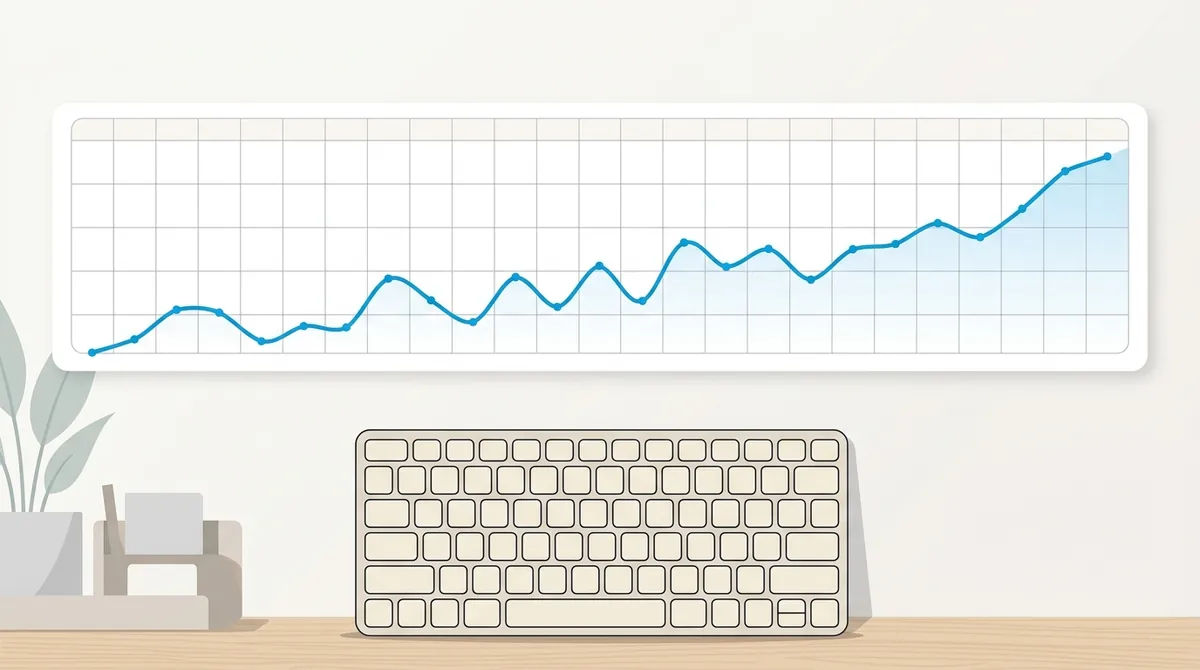
- 7. What the climb looks like
- 8. What you're actually building
- 9. The daily session that works
- 10. Why your recorded number should be the middle one
- 11. What slows people down
- 12. Where numbers and punctuation fit
- 13. Does the keyboard matter?
- 14. A realistic schedule
- 15. What to do now
- 16. Frequently Asked Questions
Quick answer
Quick answer: If you already touch type, 60 words a minute is usually a few weeks of short daily sessions away. If you still look at the keys, it's months, because you have to unlearn first and your speed will drop before it rises.
The honest variable is not hours. It's whether your hands already know where the keys are.
I read the published speed bands before writing this, because most timelines online are invented.
What 60 actually represents
The commonly cited average for copying text is about 32.5 words a minute.
So 60 is close to a doubling of the average. That's a real achievement and it's also well inside the professional range, which is usually placed at 43 to 80.
It's the speed where typing stops interrupting your thinking for most everyday work.
That's why it's the right target for almost everybody, and why 100 is usually the wrong one.
The one thing that sets the timeline
Everything depends on which of two people you are.
If you touch type, meaning you never look down, you're already using the right movement and you just need it to be faster and cleaner.
If you look at the keys, your eyes are part of the loop, and eyes are slow. No amount of practice at that style gets you far past the low forties.
So the first question is not how long. It's which road you're on.
If you already touch type
The work here is small and boring, which is good news.
You're looking at short daily sessions rather than long ones, because typing practice stops paying after about fifteen minutes in a sitting.
Most of the gain comes from accuracy rather than hand speed, which we worked out in accuracy versus speed.
For someone in the forties, a few weeks of that usually reaches 60.
If you still look at the keys
This is the harder road and it's worth taking.
Switching means your speed falls for a while. You'll go from a comfortable forty down to fifteen, and it will feel like going backwards.
That dip lasts days to weeks depending on how often you practise, and almost everyone who quits, quits during it.
The way through is to keep the old style for real work and use the new one only for practice. Trying to switch during an urgent email is how people give up on day two.
We went through whether the switch is worth it at all in hunt and peck versus touch typing.
The arithmetic of practice time
Fifteen minutes a day is 7.5 hours a month. Over three months that's about 22 hours.
That sounds small, and it's more focused practice than most people ever do deliberately.
Compare it to an hour once a week, which is four hours a month and far less effective, because the gaps let your hands forget.
Frequency beats duration here by a wide margin, and it's the single easiest thing to get right.
What the climb looks like
Progress is not a straight line and expecting one causes most of the frustration:
- The first two weeks feel fast, because the easy errors disappear.
- Then a flat stretch, often two or three weeks long, where nothing moves.
- Then a jump, usually after a session that felt no different from the others.
That flat stretch is normal and it is not a sign the practice stopped working.
What you're actually building
I ran the numbers on what the jump actually asks for. Going from 30 to 60 words a minute means your hands go from 150 characters a minute to 300, because a word is counted as five characters.
That's two and a half keystrokes a second, sustained, with the right finger each time.
It's not twice the effort. It's a different way of moving, where letter pairs fire as single motions instead of one key at a time.
You can't get there by trying harder on individual keys. You get there by repeating common pairs until they stop being two decisions.
Which is why passages of ordinary English work better than random letters. Real text contains the pairs you need, in the proportions you'll actually meet them.
The daily session that works
Keep it short and keep it the same:
- Two minutes warming up, where the score doesn't count.
- Ten minutes at a pace where you rarely make mistakes.
- One timed test at the end, recorded.
That's it. Anything longer and your arms tire, which teaches your hands the wrong lesson.
Why your recorded number should be the middle one
Take three tests and write down the middle result, not the best.
Your best is the luckiest passage on the luckiest day, so it moves around and tells you nothing about progress.
The middle moves slowly and honestly, which is exactly what you want when you're tracking weeks.
It's also far less discouraging, because it doesn't set a record you then fail to beat for a fortnight.
What slows people down
Four things account for most stalled progress:
- Practising at full speed, so the hands rehearse errors.
- Long sessions that end with tired arms.
- Switching between tests, so the numbers aren't comparable.
- Looking at the keyboard for the awkward keys only, which keeps the eye in the loop.
That last one is the sneaky one. Partial touch typing is still eye typing, because the glance breaks your rhythm whether it happens once a sentence or once a word.
The fix is unpleasant and short. Cover your hands with a cloth for a week of practice sessions and let the accuracy sort itself out.
Where numbers and punctuation fit
Almost nobody practises these, and almost every real typing task includes them.
The number row is a long reach and the shift combinations are two jobs at once, so both are error factories.
If your test passages are plain lowercase words, your score will flatter you badly the moment you type an email. A password, a phone number or a bit of code will feel like starting over.
Add punctuation to your practice once you're near the target. Not before, because it'll wreck your accuracy work while the basics are still settling.
Capital letters are the first ones to add, since they appear in every sentence you'll ever write.
Does the keyboard matter?
Less than the internet suggests, at this level.
Any keyboard where the keys work and the spacing is standard will take you to 60. A nicer one makes practice more pleasant, which matters only because it keeps you turning up.
What does matter is using the same one every day while you're learning.
Switching between a laptop and a desk keyboard mid learning slows you down, because the reaches differ slightly and your hands are still calibrating.
A realistic schedule
For a touch typist in the forties, four to six weeks of fifteen minute sessions is a fair expectation.
For someone switching from looking at the keys, two to four months is honest, with the first few weeks spent slower than you started.
Those are ranges rather than promises, because starting accuracy varies more than starting speed does.
The published bands in the words per minute reference are the anchor for where you're heading.
What to do now
Decide which road you're on, by covering your hands and typing a sentence. If that's impossible, you're an eye typist and the switch comes first.
Then set a fifteen minute daily slot and use practice mode with a fixed length.
Record the middle of three tests once a week, not every day.
Check back in a month. That's the shortest window where the graph means anything.
Frequently Asked Questions
How long does it take to reach 60 WPM?
If you already touch type and sit in the forties, four to six weeks of fifteen minute daily sessions is a fair expectation. If you still look at the keys, two to four months is honest, and your speed will drop before it climbs.
Is 60 WPM a good typing speed?
Yes. It is close to double the commonly cited average of 32.5 words a minute for copying text, and it sits inside the professional range of 43 to 80. It is also the point where typing stops interrupting your thinking for most work.
How much should I practise each day?
Fifteen minutes is enough and more is usually worse. Typing practice stops paying after about that long in one sitting, because tired arms teach your hands the wrong movement. Frequency beats duration here by a wide margin.
Why has my typing speed stopped improving?
A flat stretch of two or three weeks is normal and comes after the early easy gains. It usually ends with a jump after a session that felt no different from the others. Practising at full speed, with errors, is the other common cause.
Do I have to learn touch typing to reach 60 WPM?
In practice, yes. If your eyes are part of the loop, they become the limit, and eye typists rarely get far past the low forties. The switch costs you speed for a few weeks and it is the only route past that ceiling.
Should I track my best score or my average?
Take three tests and record the middle one. Your best is the luckiest passage on the luckiest day, so it jumps around and tells you nothing about progress. You can run a fixed length test on our typing test.
Ready to Test Your Typing Speed?
Take a free typing test, practice touch typing, or race against others in real-time multiplayer races.
Start Typing Test →Related Articles
Typing Accuracy vs Speed: Which Comes First
Every one percent of errors costs you about 2.4 words a minute at normal hand speed. Here is the arithmetic, and what it means for practice.
Who Is the Fastest Typist in the World Now?
There is no official typing speed record any more. Guinness dropped the category in 1987, and what replaced it is not comparable. Here is the real picture.
Is 100 WPM Fast? How Rare It Really Is
A hundred words a minute sits above what professional typing jobs ask for and below what competitive typists reach. Here is where it really lands.