Blank Keycaps: What They Do to Your Speed
Blank keys don't make you faster. They make you find out whether you were really touch typing, which is a different and more useful thing.
TypingFastest Team
Typing speed & productivity experts • About us
In This Article
- 1. Quick answer
- 2. What the legends are actually for
- 3. Almost nobody is a pure touch typist
- 4. The first week is bad
- 5. The second week is the useful one
- 6. Where the number row hurts most
- 7. Symbols are worse than numbers
- 8. Do blank keys make you faster
- 9. The cheaper version of the same experiment
- 10. Shape matters more than printing
- 11. The home row bumps become critical
- 12. What about shared computers
- 13. A second language layout complicates it
- 14. Learning to type on blank keys from scratch
- 15. How long the adjustment takes
- 16. Who should actually do this
- 17. Measuring it honestly
- 18. Frequently Asked Questions
Quick answer
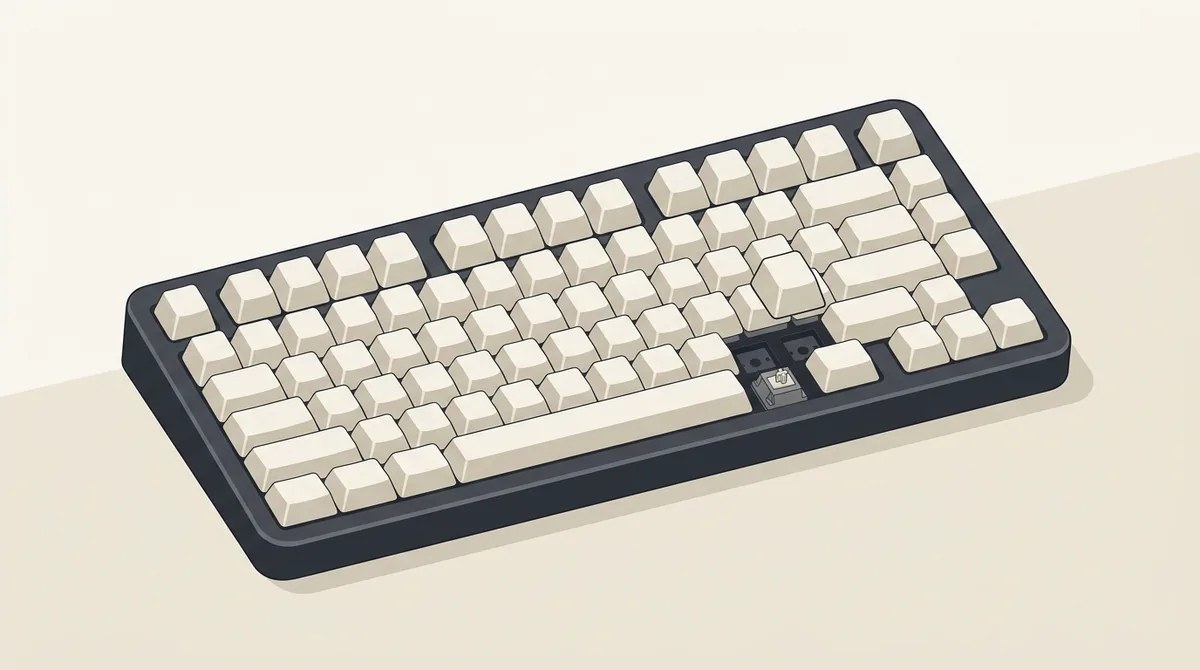
> Quick answer: Blank keycaps won't raise your speed on letters. They will expose every key you were secretly glancing at, which is usually the numbers, the symbols and the ones near the edges.
Expect a rough fortnight, then a return to roughly where you were.
I read through what people report after switching and the pattern is consistent. Letters recover fast. Brackets and the number row take much longer than anybody plans for.
What the legends are actually for
The letters printed on a keycap exist for people who look.
If you genuinely touch type, your eyes are on the screen and the printing does nothing at all. You could cover the board with a towel and type the same paragraph.
So removing them changes nothing for a real touch typist, by definition.
Which is exactly why they're a test rather than an upgrade.
Almost nobody is a pure touch typist
Here's the honest part. Most people who say they touch type do it for letters and cheat everywhere else.
A quick glance for the number seven. A look down for a bracket. A check before hitting the key beside Enter.
Those glances are short enough that you don't notice yourself doing them.
Blank keys make them impossible, and that's the entire value. You find out where the holes are within an hour.
The first week is bad
Speed drops noticeably, and accuracy drops further.
Most of the loss isn't letters. It's hesitation, because the moment you'd normally glance you now stop instead.
That pause is half a second and it happens often enough to wreck a test.
The fix isn't practice on the whole keyboard. It's practice on the specific keys you were glancing at, which you can now name.
Keep a note of every key you stall on during the first two days. That list is short, specific, and it's the whole training plan for the month.
The second week is the useful one
By the second week the letters are back to normal. That part's quick, because you already knew them.
What's left is the real learning, and it's all in the number row, the symbols and the keys on the far right.
Those are the ones nobody drills, because a test passage rarely includes them.
So blank keycaps push you into training exactly the keys you'd otherwise avoid for years.
Where the number row hurts most
The number row is the single biggest casualty.
It's further from home position than anything else you use often, so your fingers have less feel for the distance, and there are ten of them in a line with nothing to distinguish one from another.
Seven and eight are where most people stall.
Counting out from the F and J bumps is the method that works, and it's slow until it suddenly isn't.
The shifted symbols above the numbers are worse again, because now you're counting out and holding a shift at the same time.
Symbols are worse than numbers
Brackets, braces, the pipe, the tilde. All of them need a shift and a reach, and most people have never learned where they are.
With legends you glance. Without them you're stuck.
This hits programmers hardest and helps them most, because those keys are the ones they use constantly and know least.
We put together drills for exactly these in the symbols guide.
Do blank keys make you faster
No, and anybody selling them on that claim is wrong.
Your hands don't move faster because a key is unmarked. The keycap shape, the switch and your technique all matter. The printing doesn't.
What you get is a forced end to a bad habit, and the speed that follows comes from fixing the habit rather than from the keys.
You could get the same result by covering your hands with a cloth for two weeks, for free.
The cheaper version of the same experiment
Put a tea towel over your hands, or a cardboard shelf above the keyboard.
You get the identical effect for nothing, and you can stop whenever you like.
The only thing blank keycaps add is that you can't cheat when you're tired, which is a real advantage and the reason people buy them anyway.
Try the towel first. If you get through a week comfortably, buying the keycaps is a fair choice.
Shape matters more than printing
If you're spending money on keycaps, the shape is what actually affects typing.
I compared sculpted sets against flat ones. Rows angled differently give your fingers far more positional information than a flat set does. Deeper dishes keep your fingertip centred.
Those things change how often you drift off position. The printing never did.
We compared the options in our keycaps piece.
The home row bumps become critical
On a normal keyboard the small ridges on F and J are a convenience. On a blank board they're your only landmark.
So check they're pronounced before buying. Some cheaper blank sets have shallow bumps you can barely feel, which makes the whole exercise much harder.
Every reach you make should end with a return to those two keys.
That habit is the foundation, and we went through it in the home row guide.
A second language layout complicates it
If you type in more than one layout, blank keys remove the only thing telling you which one you're in.
Accented characters, different punctuation positions and a moved Y or Z all become guesswork.
For a single layout typist this doesn't apply at all.
For everyone else it's a genuine reason to keep at least the letters printed, and there's no shame in that.
Learning to type on blank keys from scratch
Some people suggest starting a beginner on a blank board so they never learn to look.
It does work, and it's miserable. A beginner needs to find the key at all before they can find it by feel.
The better order is to learn the letters normally, then go blank once you're up to about thirty words a minute.
Our practice mode covers the letter drills you'd want before making the switch.
How long the adjustment takes
Letters, a few days. The number row, a couple of weeks with deliberate drilling. Symbols, a month or more if you use them rarely.
Those figures assume you practise the weak keys rather than just typing normally and hoping.
Typing normally does work, but it takes months, because a normal passage almost never includes a brace.
Drill what's missing and it collapses to weeks.
Who should actually do this
Somebody who already types above about fifty words a minute and wants to stop glancing.
Somebody who writes code and keeps hunting for brackets.
Somebody who types in one layout on a personal machine.
Not a beginner. Not somebody who shares the computer. And not somebody expecting the keys themselves to add speed, because they won't.
If you're unsure which group you fall into, the towel test answers it in a week and costs nothing.
Measuring it honestly
Test before you switch, five runs, take the middle value.
Then test weekly on the same passage length.
You'll see a dip, then a recovery to roughly where you started, and then slow improvement as the weak keys catch up. That last part is the payoff and it takes a couple of months to show.
If you're not back to your starting number after a month, the drills are missing rather than the idea.
Frequently Asked Questions
Do blank keycaps make you type faster?
Not directly. The printing on a key does nothing for someone typing by feel, so removing it adds no speed. What it does is stop you glancing down, which forces you to learn the keys you were cheating on. The speed comes from that, not from the keycaps.
How long does it take to adjust to blank keycaps?
Letters come back within a few days because you already knew them. The number row takes a couple of weeks of deliberate practice. Symbols and brackets take a month or more, because ordinary typing passages almost never include them so you never drill them by accident.
Can I get the same effect without buying keycaps?
Yes. Put a tea towel over your hands or a piece of card above the keyboard. It's free, identical in effect, and reversible in a second. The only real advantage of blank keycaps is that you can't cheat when you're tired at the end of a long session.
Should a beginner learn on blank keys?
No. A beginner needs to find a key at all before finding it by feel, and blank keys make that needlessly painful. Learn the letters on a normal keyboard first, get to about thirty words a minute, and switch after that if you want to. Our muscle memory guide covers the stage before this one.
Which keys are hardest without legends?
The number row, because it sits furthest from home position and ten identical keys sit in a line. After that, symbols and brackets, which need a shift plus a reach and which most people never properly learned. Drill those two groups specifically rather than typing normally and waiting.
Ready to Test Your Typing Speed?
Take a free typing test, practice touch typing, or race against others in real-time multiplayer races.
Start Typing Test →Related Articles
Does Typing Speed Drop Late at Night
Your fingers follow the same daily clock as your reaction time. Here's when typing speed peaks, when it collapses, and how much of it you can shift.
CPM vs WPM: Characters Per Minute Explained
One of these numbers is about five times the other, and they measure the same typing. Here's how to convert between them and which one an employer means.
How Many Retakes Before a WPM Score Is Real
One typing test tells you almost nothing. Here's how many runs it takes before the number settles, and which number to actually write down.